
Born Last, Going First.

I was born last. The youngest of ten. The baby. By the time I arrived, the house was already full of children up to age 12. The oldest was on the cusp of growing up, and that process gets very rushed with there are 9 others, chores, homework and putting your own needs last.
But a house with eleven other individuals does something when you are becoming. It’s like eleven tutors 24/7. There were tutors for every opinion, habit, talent and subject. I simply had to just take it in, like osmosis, and decide what suited me, then discard the rest (a little bit like the hand-me-downs, of which there were plenty.) With that many siblings, I could be schooled by the best in everything from trumpet, skipping school, track and field, ironing, attracting boys and dating, cheerleading, sneaking out of the house, avoiding church, sewing, baking cakes, the Beatles, hot-wiring cars, or becoming prom queen. My siblings were and are, multi-talented.
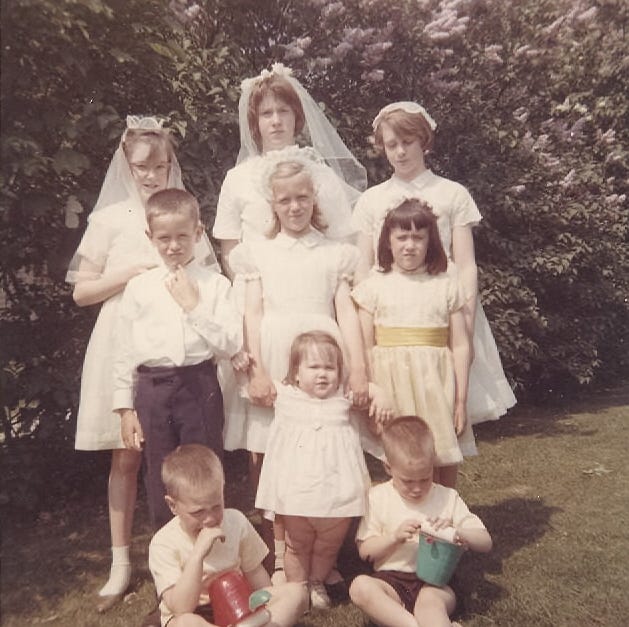
And because we were 10 in 12 years, there was always someone’s clothes, car, or album to borrow, as well as someone to laugh with, fight with or share that last bite of dessert. But with that many people, there are also opinions in every corner. The music is playing whether you like it or not. The politics are determined in advance, and you are expected to get to church. Like all anchor legs of the relay, I got the baton last, I was carefully watching the first three legs of the race.
Once I grabbed the baton, though, it was mine to bring across the line - and I am now just pulling out in front, in my 60s.
Of course, by all visible standards, I may have felt I was always pulling ahead, leading and doing great. But when there is a quiet craving deep inside like there has been for me, leaning into it fully, can feel exhilarating.
If any of this resonates with you, dear reader, has there always been something circling throughout your life that you cannot name?
—
For most of my life, being last was a gift. The youngest of ten doesn’t have to figure out the world from scratch. She absorbs it. I inhaled the world around me, watching my sisters sew beautiful clothes out of fabric they bought themselves, and watching my brothers play trumpet, fix cars, and run track like I was the president of their fan club. I learned what to wear, what to read, what to want, what to laugh at, by watching the people I loved and copying their cues. By the time I was twelve I had opinions about Vatican II, knew the Clancy Brothers music and could name Red Sox players, but these weren’t my passions nor interests. I was a mile high and an inch deep in what I could pick up around me. Like a party trick, I could recite, share, tell or recount something funny on command for the entertainment of others. (my father once bought a Citroen, the French car brand, and would parade me out to pronounce it with a trilling flourish for laughs.) Thank goodness those days are over. Amen.
I am also an extravert, which speeds the whole process up considerably. I tried things on quickly. I was a person early. By 15, I had a personality and a growing bank account from my many jobs. By 20, a gap semester to Europe opened my eyes and my mind. By 30 I had a career, and by 40, a methodology for brands to find their true purpose. By 50 I had a business with a list of admirable clients, a beautiful house, family and way of being in the world that felt seamless. I was traveling the world and pinching myself much of the time.
What I had not done — what it took sixty-some years to do — was to ask, what is truly you?
—
Here is the other thing about being a woman born when I was born. We were the first ones told we could be anything. Be President. Be a CEO. Be a doctor. Be a partner at the firm. Also: be pleasing, be available, be talented, pretty, nice, and while you are at it, make the cake, remember the birthdays, run the home, keep the peace, be smart, and look nice while you do it. We were given the assignment of becoming everything, and in my house, without many resources, and without anything resembling a map.
A lot of us became, as a survival strategy, the CEOs of our own lives. We had to. Who else was going to do it? We learned to run the operation - the household, the career, the relationships, the calendar, the in-laws, the school applications, the boards of directors, the PTA, the laundry, the family memory — like a small enterprise, on grit and competence and the persistent low-grade dread of dropping a ball.
A lot of us are very, very good at this.
Which brings me back to now. When we stop. What is it we are still dying to do or be?
What are you circling that you cannot name?
—
For thirty years, I made a living helping other people figure out who they were and how to say it. Brand strategist, the title says. Purpose-driven companies, the good kind — Stonyfield Farm, The Body Shop, Honest Tea, Lindblad. I named a methodology. I built a board game out of it. I worked with the Dalai Lama’s compassion curriculum, which is the kind of sentence that startles me even now when I type it. I was good at my work. I was paid well. I was, in the language of women of my generation, successful.
I was also, it turned out, still the youngest of ten. Still watching. Still absorbing. Still defining myself by what the room needed. I had built a thirty-year career on the very skill that had been my survival strategy since childhood: I noticed what other people were trying to say, and I helped them say it. I learned by doing. Then I tried it, iterated, and improved.
I was succeeding by all accounts, even my own.
And then, trying on the questions that I use in my client workshops, I had a bit of an epiphany:
What if I answer these questions about me, what might I learn?
Who am I?
Where do I come from?
Where am I going?
What for?
What am I willing to risk to get there?
For three decades I sat in conference rooms with founders and CEOs and helped them work through these. Companies discovered themselves through these questions. Brands found their voice. Mission statements stopped being meaningless. I watched it happen, over and over, and never once, in thirty years, thought to ask the questions of myself.
And then I sat with these questions myself. I knew why I had created them in my framework and what they revealed. I knew how powerful they could be. I watched team members become emotional in answering them. I knew that when answered honestly, they might be able to help me understand the unsettled feeling I had been having. One I couldn’t really name.
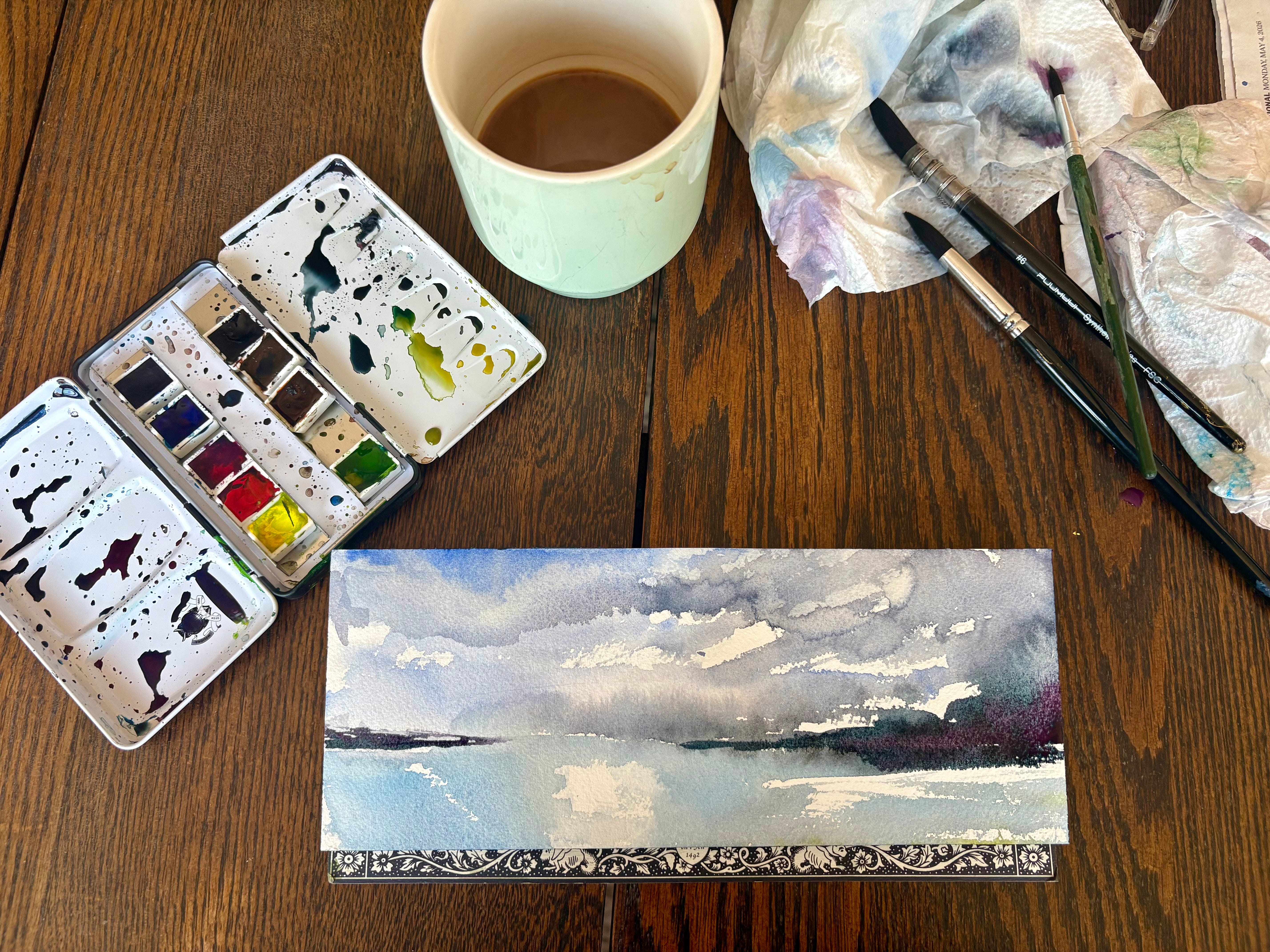
I felt myself having inner cravings around creativity. I couldn’t stop looking at art, doodling, drawing on scraps of paper and imagining whole collages, re-done rooms in vibrant colors or making greeting cards for friends in need. A colleague sent a painting set as a random holiday gift, and when my husband asked who we might re-gift it to, I felt possessive, like I had to open it immediately and start expressing myself.
So I did.
I remember the day I started to paint quite vividly. It was a poor attempt, but I felt thrilled.
That very mediocre painting was one of the ways that I answered the very questions I use with clients about getting to one’s why. And that answer, in watercolor, was about as true as it can get. It was an answer that spoke, for the first time, in my longing voice.
It said, I am this.
For me, the answer turned out to be paint.
Not because painting is precious, or noble, or what I am supposed to be doing at this age — which is also, by the way, a thing women of my generation are now being told. Find your passion. Find your creative practice. Do something with the second half.
For me, I started painting with my mother when I was 12, in oil and with a palette knife. But like many childhood crafts and hobbies, it went by the wayside when I was eager to grow up and go into the world. But it didn’t go away. It just lay dormant until that paint kit reawakened its voice. It turns out that the answer to who am I had been sitting in a random holiday gift box until I decided to open it up a few years ago.
For you, it will be something else. I cannot tell you what. I have a guess, though, which is that you already know, and that you have been not-quite-looking at it for a long time.
For you it might be a career you walked away from and have been quietly missing. Or a career you never let yourself have because someone needed something more reasonable from you. It might be a passion you abandoned at twenty-two when life got serious. It might be a grief you have been performing around instead of through. It might be a friendship you let lapse, a language you started learning, a city you keep looking up flights to without ever booking one. It might be a name you stopped saying out loud — your own, in some private version.
The point is not the answer.
The point is whether you are willing to ask.
What are you circling that you cannot name?
—
I do not have a method to give you. I do not have a five-step framework this time. (nor would I give it to you even if I did). Those days are over. Amen again.
What I have is one woman in her sixties who has decided, after a lifetime of going second, third, fourth, tenth — who has decided, in the time she has left, to go first.
Not because I have arrived. Because somebody has to walk out into the field and tell you what is out there. The water is fine. The painting is getting better. The light at dawn and dusk is the best. The questions, when you finally ask them of yourself, will not destroy you, although they may rearrange you.
Born last is what I was. Going first is what I am.
I invite you to come with me, and I am so glad you are here.
— MJ
Love this post! You have articulated so beautifully what I help 60+ women reclaim - their essence. Congratulations!
You are in a new season of life.. happy for you.